Editable AI Design Versus Static AI Image Generation
Editable AI design keeps assets flexible; static generation locks them into pixels.
The real fault line in AI-powered visual work has nothing to do with AI replacing designers. It runs between two kinds of output: the kind a team can still touch after it's made, and the kind that locks the moment it finishes rendering. That distinction decides whether a tool belongs in an actual business workflow or just a mood board.
Most teams end up running two separate tools without quite admitting it to themselves, one for design and one for image generation, because those tools are built to answer two different questions. One asks what something should look like. The other asks whether you can still change it next Tuesday when the campaign needs a new headline. A text-to-image generator answers the first question well. It has no mechanism for answering the second, because the moment it finishes, the picture is the picture.
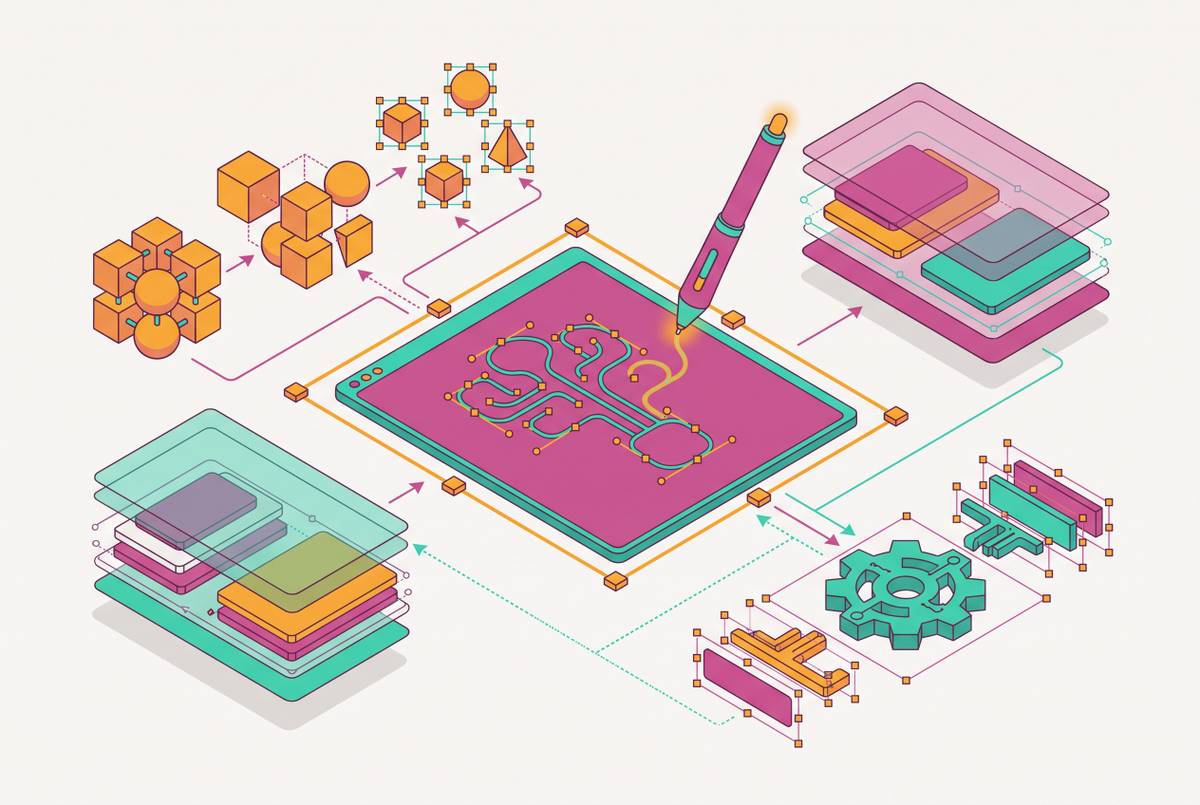
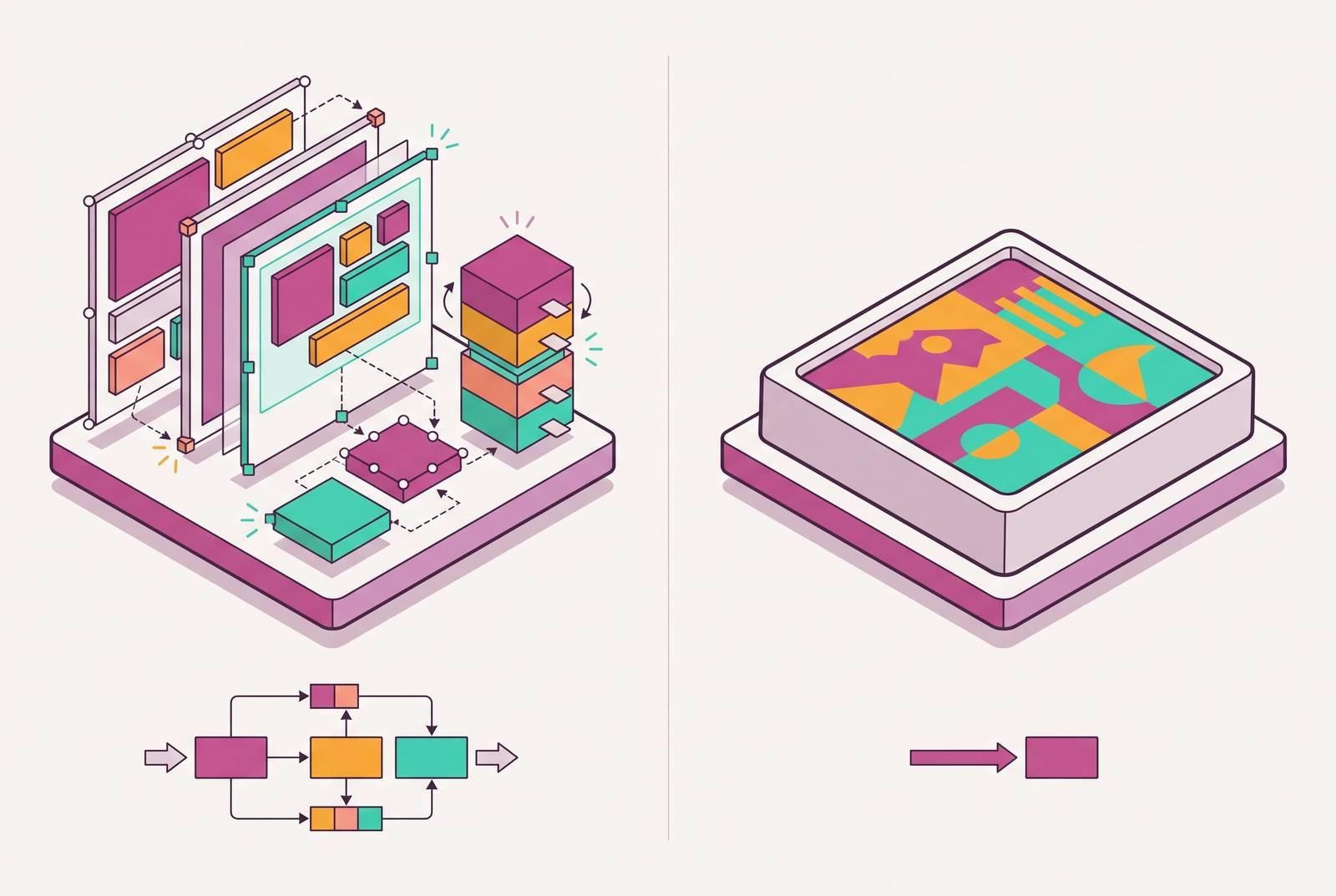
Static AI image generators produce raster files. That means flat, resolution-dependent images locked down to the pixel: rescale one past its native resolution and the edges turn to mush, try to recolor it and you're opening a second tool entirely, and if one element needs updating, the whole image gets regenerated from scratch, logo and background and headline all over again. Editable AI design platforms work on a different principle. They produce layered output, with text, shapes, images, and brand elements sitting as separate, movable objects on a canvas, so a single color swap doesn't force a full rebuild. One output is a photograph of a finished design. The other is the design file itself, still open, still responsive to a cursor.
Graphic design tools built on AI have moved well past the early text-to-image days. Platforms now ship native vector output, typography that's actually production-ready instead of decorative, real-time editing, and custom style training tuned to a specific brand's look. None of that closes the gap between editable and static. If anything it widens it, since the editable side keeps adding capability while the static side keeps doing the one thing it has always done: turn a prompt into a fixed picture. Which tool a team picks determines something more practical than taste: whether the resulting asset fits into an actual workflow or becomes a one-off that gets quietly reworked by hand the second the brand needs it to flex.
Static AI image generation
Static generators are good at exactly one job, and it happens to be a job worth doing well: turning a text prompt into a striking, high-resolution image. That's a real capability, not a lesser one, and it earns a spot in plenty of design workflows, so long as nobody asks it to do more than it's built for.
Midjourney, Adobe Firefly's image engine, and Ideogram all sit in this category. Their design priorities are aesthetic quality, how closely the output matches the prompt, and how many usable variations come out of a single run. None of them are built around what happens after generation, because editing was never the job. Firefly has a particular edge for business use: Adobe trains it on Adobe Stock images, openly licensed content, and public domain material where copyright has expired, which gives it a commercial-safety case that prompt-only tools can't easily match. It lives inside Photoshop, Illustrator, and Express, and it also runs as a standalone web app at firefly.adobe.com, with a free plan offering a limited number of credits and paid tiers stepping up from Standard to Pro to Pro Plus to Premium as the credit allowance grows.
Within its lane, that lane is wide. Mood boards, art direction references, background imagery, hero images for a webpage, conceptual illustration, and product photography stand-ins all treat the image as a finished artifact. Nobody needs to go back into a hero image and retype the headline next quarter, so the fact that it's frozen the moment it's generated costs nothing.
The limit appears the instant the image has to carry something that needs to change. Brand colors, a specific typeface, a logo, a call to action, anything that has to vary by campaign or audience, and a flat raster file simply can't flex to meet it. Every variation means a fresh regeneration. It re-rolls the aesthetic dice on an image that was already approved once.
There's a legal wrinkle business users should sit with before treating any of this output as a finished deliverable. The US Copyright Office concluded in January 2025 that purely AI-generated material doesn't qualify for copyright protection, and that writing the prompt alone doesn't make a person the legal author of the result. For anything tied to brand identity, that argues for treating the generated image as a sketch a designer still has to develop. None of this makes static generation a lesser tool. It makes it a tool built for a specific job, and the job it's bad at happens to be the one business teams care about most: producing an asset that still has to change after it's born.
Editable AI design and its output structure
Editable platforms generate the design itself, as a structured set of layers that stay independently controllable after the fact, each one open to resizing, rebranding, or swapping without disturbing anything around it.
Mechanically, that works because these platforms apply composition rules, typography systems, and color theory at generation time, producing a complete visual where text, shapes, background, image, and logo all remain separate, editable objects once the thing is built. Nothing gets flattened into a single pixel layer the way it does with a raster image. Editable platforms like Moda represent this structural approach directly: the design holds its parts as discrete, movable objects on a canvas, so any one of them can change without a full regeneration.
Moda, specifically, treats every output this way, whether it's a slide deck, a social post, an ad, or a PDF, generating each as a fully controllable asset on a real canvas. Websites can also be created and published through the same agent, as their own output type. A user can move an element, recolor it, retype it, or swap it out entirely, and the rest of the composition stays exactly where it was. Brand Kit integration adds another layer to that: colors, fonts, and logos apply automatically the moment something is generated, and they stay editable afterward instead of getting baked into a pixel layer the way they would in a raster file.
That architecture changes the math for anything produced across more than one format. A team running a campaign across LinkedIn posts, a one-pager, a slide deck, and an ad banner can generate all four from the same brand-consistent system, make an edit once, and have it carry across every format without touching each file by hand. No regeneration, no slow drift away from what the brand guidelines actually say. Static generation has no equivalent move. Each format would need its own prompt, its own roll of the dice, and its own hope that the output happens to land close enough to the last one.
Why brand consistency breaks down with static outputs
Static generation's real cost in a business setting is a consistency problem: every regeneration is a fresh roll on colors, typography, layout, and tone, with no layer anywhere to lock a decision in place once it's been made.
Producing one good asset is easy with almost any AI tool available. Building a system of modular, reusable brand components that hold steady across campaigns, markets, and quarters is where static-output workflows start to come apart, because nothing in a raster file is actually locked. Brands that have folded AI into their campaign asset production report real reductions in turnaround time on standard creative work, which in practice means more campaigns tested and the better performers scaled up sooner. That gain is visible only when the output is something a team can reuse, not something it has to regenerate from a prompt every single time a word needs to change.
Adobe has a name for the fix it's building toward: a "brand ontology," a structured and continuously updated model of what a brand actually stands for, pulling together brand guidelines, design systems, approved assets, briefs, and the patterns that show up across past reviews into a format AI systems can read and apply. A static brand guidelines PDF sits on a shared drive and gets ignored. A brand ontology is meant to work across tools and cut down the manual review bottleneck that forms when every asset needs a human to check it against the deck nobody has opened since the rebrand.
When brand colors, fonts, and logos live inside a Brand Kit that gets applied automatically at generation and stays editable afterward, consistency is enforced by how the tool is built. One might argue that's just automation doing what a style guide was always meant to do. Maybe so, but a style guide never stopped anyone from shipping the wrong blue at 11 p.m. before a launch, and a locked Brand Kit does.
The practical line falls wherever a campaign needs more than one asset format, more than one market, or more than one quarter of use. Below that line, static generation holds up fine. Above it, static workflows start accumulating the kind of small inconsistencies that add up to a brand that looks like five different companies depending on which asset a customer happens to see first.
Editable AI design and the math for go-to-market and operations teams
For sales, marketing, and operations teams, this isn't an abstract design argument. It decides whether a team can produce its own polished, on-brand materials or stays dependent on a designer or an agency for every single revision.
Take slide decks first. Every deck produced by an editable platform, Moda among them, comes out as a layered file that can still be updated after the fact. Drop a static AI-generated image into a deck instead: it can't be resized, recolored, or revised without a full regeneration, and one branding change can cascade into hours of rework across a dozen slides. Salespeople personalizing a deck per account, or operators updating one per quarter, need to change a headline, swap a logo, or update a chart. They don't need to regenerate the whole visual from a prompt and hope it lands close to the last version. Moda is built specifically around that workflow: go-to-market teams, chiefs of staff, and growth leaders who need slides that look ready for a major corporate boardroom, built in minutes, on brand, with no designer sitting in the loop.
Social content makes the same gap sharper, maybe sharpest of anywhere in the business. It needs to become a carousel, a story, an ad variant, a different aspect ratio for whatever platform picks it up next. A flat image resizes badly or has to be rebuilt from the ground up to fit a new format. Moda covers that same multi-format workflow with full editability and Brand Kit enforcement built in, aimed at teams producing volume rather than a single creator polishing one post at a time.
That shift carries an agency-sized implication: the execution-layer work that used to justify a retainer, drafting, adapting formats, scheduling posts, is now something accessible AI tools can do directly. What used to require an outside creative team now takes one internal operator running a properly configured design system. But that substitution only holds if the output stays editable enough to iterate on without sending it back out the door. A static image generator can't support that handoff. An editable one is built around nothing else.
When static generation still earns a place
None of this makes static image generation obsolete. It's the right call for specific, bounded jobs where the output is meant to be a finished artifact, not a piece of a larger system that keeps changing underneath it.
Art direction and concepting is one clear case: generating references, mood boards, and style explorations where the goal is inspiration. Midjourney's aesthetic range and Firefly's commercial-safety grounding both earn their keep here, since nobody's shipping the mood board itself. Hero and background imagery is another: a website hero, a blog illustration, a social background that won't change and carries no text or brand element needing an update later. That's a finished artifact the day it's made, and a high-quality flat image is exactly the right format for it. Photography stand-ins and product mock-ups round out the list, generating product shots or lifestyle scenes at a fraction of what a full photo shoot costs, for another bounded, one-and-done use case.
The workflow that actually works brings these static outputs into an editable platform afterward, Moda or any other canvas-based tool, where the image becomes one layer among several inside a larger, still-editable composition. The image itself stays flat. The design wrapped around it doesn't have to.
The boundary is simple enough to hold onto: the moment a static image needs to carry brand typography, a call to action, a logo, or anything that has to change across formats or future iterations, the job has outgrown what a static generator can deliver. Keep using one past that point, and the rework recurs on every single revision.