Visual Content Cadence Planning for B2B Social Teams
Standardize formats and batching to make visual posting consistent, not just frequent.
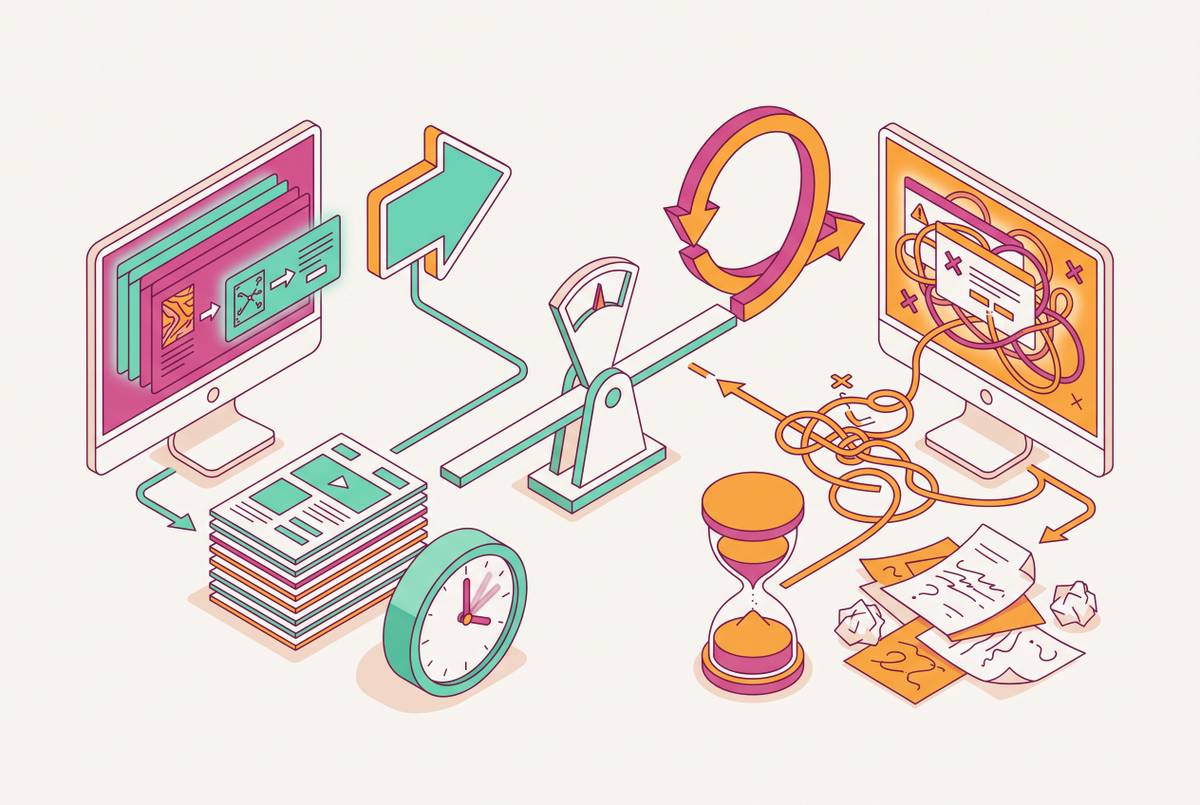
The calendar exists. The posting times are picked, blocked out in some shared doc, color-coded even. And still, the feed goes quiet for three weeks, then erupts with four posts in two days, then goes quiet again. That pattern is a production failure wearing a scheduling costume.
Most B2B social teams diagnose their visual content problem as a timing question: when should we post, how often, on which days. But a calendar only answers when to publish. It says nothing about how the asset gets made between the decision to post and the moment of publishing. Every single post, under this setup, requires its own fresh round of decisions: what does this look like, who designs it, who approves it, how long does that take. That's four decision points per post, repeated weekly, with no system absorbing the friction.
The friction compounds. A team that has to re-litigate format, design, and approval from scratch every time will burn out its production capacity long before it burns out its content ideas. And the instinct that kicks in next, usually, is to push harder: post more often, chase better time slots, add volume to compensate for inconsistency. That instinct is exactly backwards, because adding volume to a production process that's already straining under its own weight doesn't fix the strain, it accelerates the collapse. A system producing two reliable posts a week will outperform one attempting five and landing three, because the audience and the algorithm both register absence more than they register quantity.
So the real question was never about the clock. It was about the machine behind the clock, and whether that machine can run without someone rebuilding it every single week.
Why consistency beats frequency
The goal of a visual content cadence isn't maximum output, it's the highest volume a team can sustain without the system buckling, and that ceiling gets set by production capacity, full stop, not by ambition or by what a competitor is posting.
This matters because of how platforms and audiences respond to rhythm. A steady, predictable cadence compounds over time: audiences learn when to expect content, and algorithms reward accounts that publish reliably rather than in bursts. An erratic cadence, even one that occasionally spikes to a higher weekly volume, trains both the audience and the algorithm to tune out, because neither can predict when the next post is coming. Oktopost's 2026 benchmark of over 1,000 B2B LinkedIn pages gives a sense of what "reliable" looks like at the format level: document carousels in the 5 to 15 slide range perform best for engagement, a range narrow enough to standardize around, not so narrow that it kills creative flexibility.
This changes which question the team should be asking. Instead of asking how many times a week the team should post, the better question is how many assets the production system can reliably deliver each week, under normal conditions, without anyone pulling an all-nighter. That number becomes the cadence target. Not five, because five sounds ambitious. Two, because two is what gets made every single week without fail. A team that sets its target at its real capacity, then builds a system engineered to hit that target consistently, will out-publish a team chasing a frequency goal that collapses the moment someone goes on vacation.
The four components every B2B visual content production system needs
A production system, in practice, breaks into four interlocking pieces. None of them work especially well in isolation, which is itself the point: this is a system, not a toolkit of independent tactics a team can pick and choose from.
Repeatable formats come first. These are specific asset types assigned to specific content pillars, decided once at the system level rather than re-decided every time someone sits down to make a post. Second is the batching workflow: dedicated blocks of time where multiple assets get produced in one sitting, instead of one-post-at-a-time production under deadline pressure. Third is the template and asset library infrastructure that makes batching physically possible, since nobody can batch-produce ten posts in an afternoon if each one starts from a blank canvas. Fourth is the feedback loop, a recurring review that kills underperforming formats and reallocates effort toward what's actually earning attention, before the team adds more volume on top of a weak foundation.
These four pieces depend on each other in ways that make skipping one expensive. Pillars without formats produce blank-canvas paralysis, the exact problem from the opening section. Formats without a batching workflow produce the same last-minute scramble, just with nicer templates. Batching without a feedback loop produces a team that's very efficient at making the wrong things, which, arguably, is worse than being inefficient at making the right things. The next four sections take each of these in turn, starting with formats, since format selection is where the whole system either locks into place or falls apart before it starts.
Choosing and locking in the content formats that anchor your visual system
Choosing a format is the highest-leverage decision in the entire system, so it deserves more attention than rushing to pick "whatever looks good on LinkedIn. The right formats share three traits: they're repeatable without heroic effort, efficient enough to produce that a team isn't dreading the next batch, and matched to how B2B buyers actually consume content on the platform in question.
Document carousels are a strong anchor format by this standard. Oktopost's LinkedIn benchmark, built from more than 1,000 B2B pages, puts the engagement sweet spot at 5 to 15 slides, and separate guidance from Hootsuite gives the same 5-to-15 range. That's a wide enough band to let a team vary content (a five-slide quick tip versus a twelve-slide breakdown of a framework) while staying inside a format that's been templated once and reused indefinitely.
The selection test is simple: can this format be templated, produced without starting from scratch each time, and adapted across more than one content pillar? If yes, it earns a permanent slot. One-off custom graphics fall into this second category almost by definition: each one is bespoke, so each one starts from a blank canvas, the exact thing the whole system was built to eliminate. A team can certainly produce a custom graphic occasionally for a special announcement. But building a weekly cadence around a format that resists templating is like building a factory line around a product that has to be hand-carved every time. Once formats are locked, the next job is turning that decision into something fast to execute against, which is what templates are for.
Templates and Asset Libraries as Production Speed
A template is not a shortcut for people who can't design; it's the mechanism that converts a repeatable format into a repeatable production process, which turns design decisions into a process a team can run every week without redoing them.
Consider what a template actually locks in: layout, typography, color palette, image placement, text hierarchy. Once those decisions are made and embedded, the only thing left to vary from post to post is the content itself, the words and the data points. That's the entire source of the speed gain. A team isn't eliminating decisions by using a template, it's front-loading them, making them once instead of fifty times.
For B2B go-to-market teams, someone with zero design training can produce an on-brand visual asset, because the design intelligence lives inside the template rather than inside the person operating it. A good test for whether a template system actually works: can a salesperson, someone whose job has nothing to do with design, sit down and produce a finished, on-brand LinkedIn carousel without needing a designer on standby? If the answer is no, the template still has too many open decisions baked into it.
Asset libraries extend the same logic across the whole visual system. A shared library of brand-approved icons, image treatments, chart styles, and background elements means every post, regardless of who made it, draws from the same visual vocabulary. That produces brand consistency at scale without requiring a designer to review every single piece before it goes out, which matters because designer review time is exactly the kind of bottleneck that kills velocity. When brand standards live inside the template rather than in someone's head, the review process itself gets shorter: a post built from an approved template needs less scrutiny than one built from scratch, so approval stops being the step that quietly cancels out every speed gain made upstream. AI-powered design platforms that generate fully editable outputs, rather than flattened static images, suit this particular use case well, since every element stays adjustable and a team can batch-produce a run of visually consistent posts while varying the substance underneath, correcting any single element without rebuilding the whole asset from scratch.
Building the batching workflow that keeps the system running week to week
Batching is what separates a production system from a habit of reacting to deadlines. The principle is straightforward: a single production session should generate enough assets to cover the next week or two of publishing, so nobody on the team is ever creating something the night before it's due.
Video shows the logic most cleanly in how production and publishing are separated. One monthly production session can generate multiple short clips, which then get distributed across several weeks of the calendar. The act of making the video and the act of publishing it are deliberately separated in time, on purpose, so a bad week for production doesn't translate into a bad week for the feed.
Static visual assets follow a tighter rhythm. A weekly or biweekly batching session, run against templates that are already built and waiting, can produce enough carousels, graphics, and social posts to sustain a steady LinkedIn cadence without anyone doing daily creative work. The approval step belongs inside this same session, not tacked on afterward as its own separate ordeal. Reviewing a week's worth of assets in one pass takes a fraction of the time that reviewing each post individually as it's created would take, and it means approval never becomes the thing standing between a finished asset and a scheduled post.
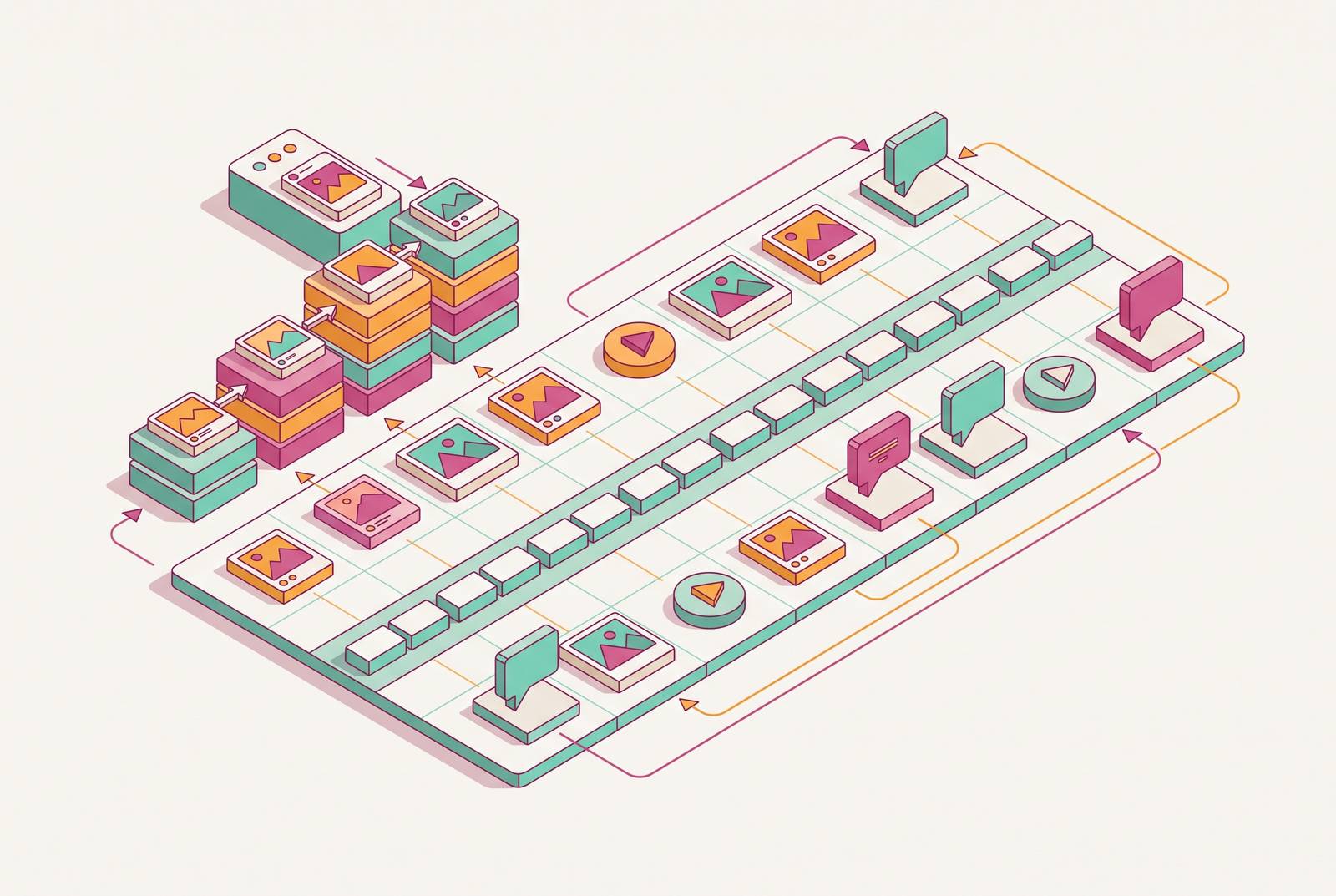
What starts to take shape here is less a content calendar and more an operating system: pillars feeding formats, formats feeding templates, templates feeding batches, batches feeding a publishing schedule that runs on its own momentum. A calendar tells a team when to post. An operating system tells it how the post gets made in the first place, which is the piece a plain calendar was never built to handle.
Keeping the System Aligned With What Works
A production system without a feedback loop is a machine that gets efficient at making the wrong things. Once formats, templates, and batching are running smoothly, a team can hit its weekly cadence target indefinitely while slowly drifting away from the content that's actually working. The feedback loop is what catches that drift before it compounds.
Monthly review is the natural cadence for this kind of audit. The review asks which formats keep earning attention, which topics have replay value worth repeating, and which posts created operational drag: legal review delays, assets that were painful to source, sign-off chains that dragged on across multiple stakeholders. Formats that keep generating that kind of friction get redesigned or retired, regardless of how well they perform, because operational cost is a cost even when engagement looks fine on paper.
For B2B teams, the metric worth anchoring this review to is account-level engagement, not follower counts. A format can look like a hit by raw like-count and still be irrelevant if the accounts engaging with it are nowhere near a buying decision.
What the review changes is content allocation: more production effort toward formats and pillars that earn account-level engagement, less toward the ones that don't, and retirement for anything that keeps creating operational headaches disproportionate to its payoff. What the review does not touch is the system's architecture itself. All of that stays stable, because the review is adjusting what flows through the system, not rebuilding the system every month, and that stability is what makes a sustainable cadence possible in the first place. Teams that build this review into their production system are the ones whose cadence compounds, month over month, because they're correcting course based on actual signal rather than guesswork. Teams still treating visual content as a calendar problem are the ones still staring at a color-coded doc, wondering why the posts stopped showing up.